Path-Specific Analysis
Causal pathways, longitudinal mediation, and health disparities.
1. Longitudinal Studies with Repeated Treatments and Multiple Mediators
⁉️ How can we conduct estimation and inference for identifiable natural path-specific effects in longitudinal studies with repeated treatments and varying numbers of mediators?
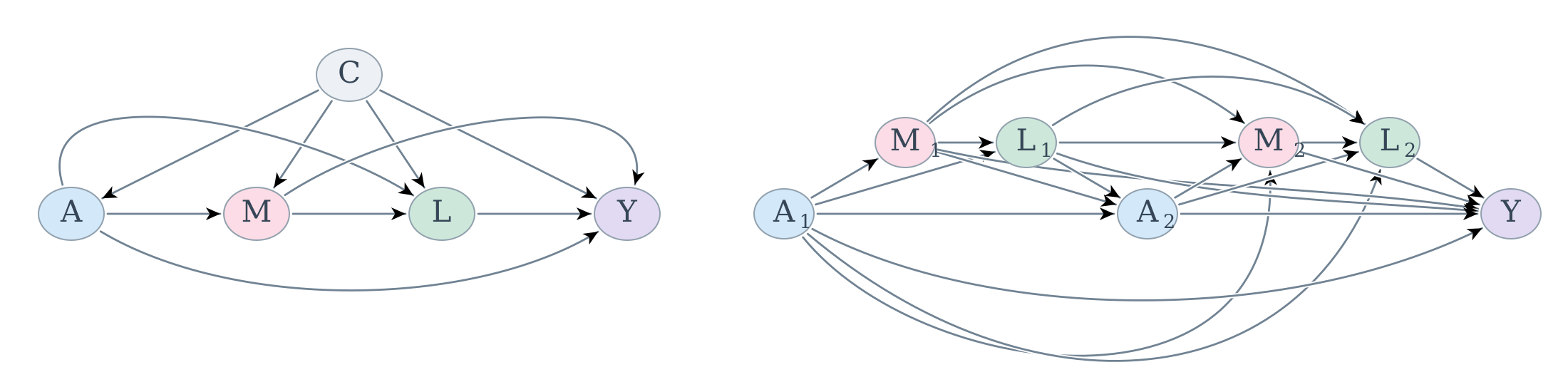
- A flexible framework for path-specific effects with repeated treatments and multiple intermediate variables, allowing their number, type, and causal ordering to vary across treatment occasions.
- Two representations of the efficient influence function and corresponding one-step estimators:
- The first uses conditional intermediate-variable densities.
- The second combines sequential regressions with Bayes' rule to avoid direct density estimation.
- Blockwise multiple robustness for the density-based estimator and sequential multiple robustness for the regression-based estimator.
- Sensitivity analysis for cross-world assumptions in a special case of our framework.
2. Flexible Implementation of Path-Specific Analysis
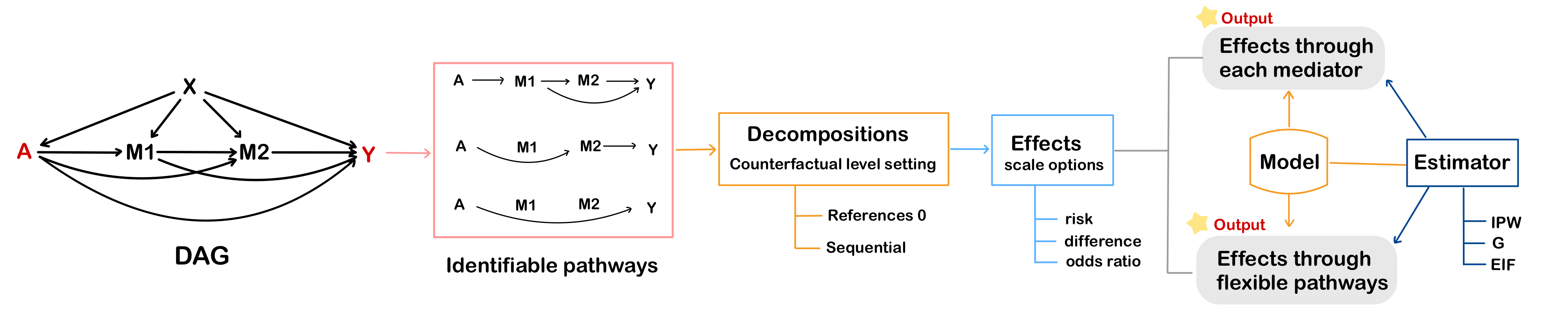
flexPaths is an R package for estimating causal path-specific effects. It supports varying numbers of treatments and mediators, flexible choices of identifiable pathways and effect decompositions, and a range of statistical models and estimators.
3. Racial Disparities in Healthcare Expenditures
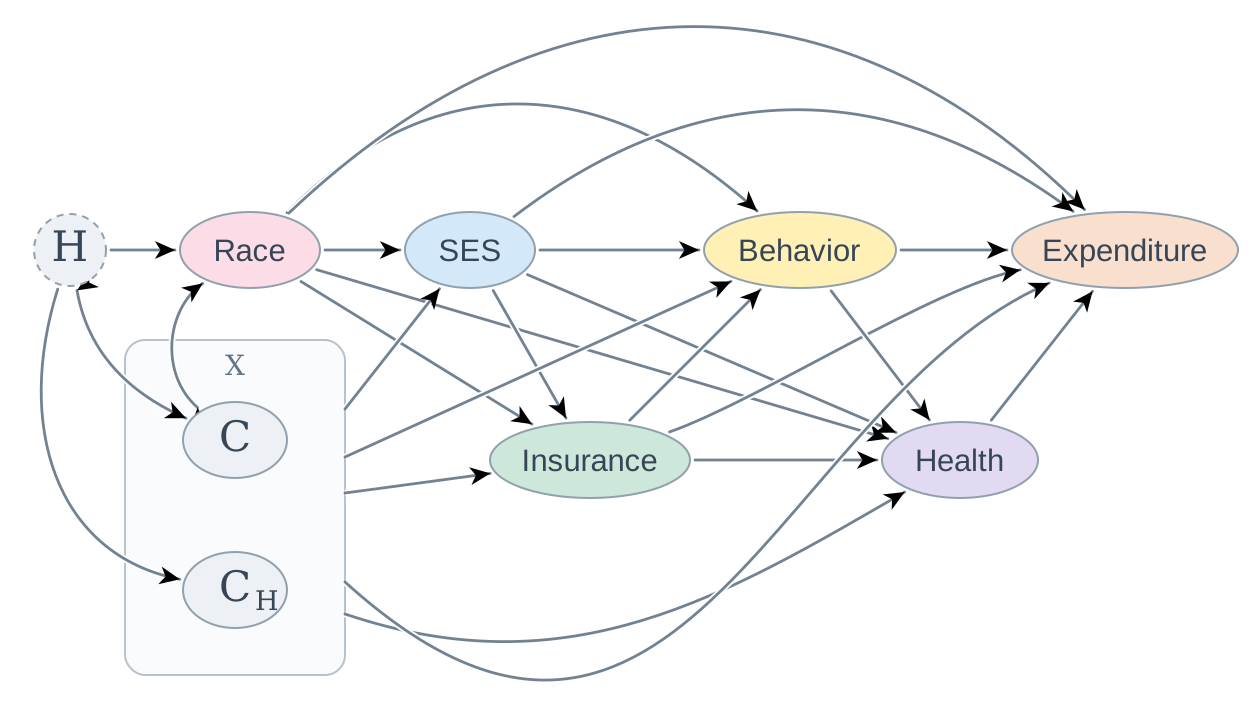
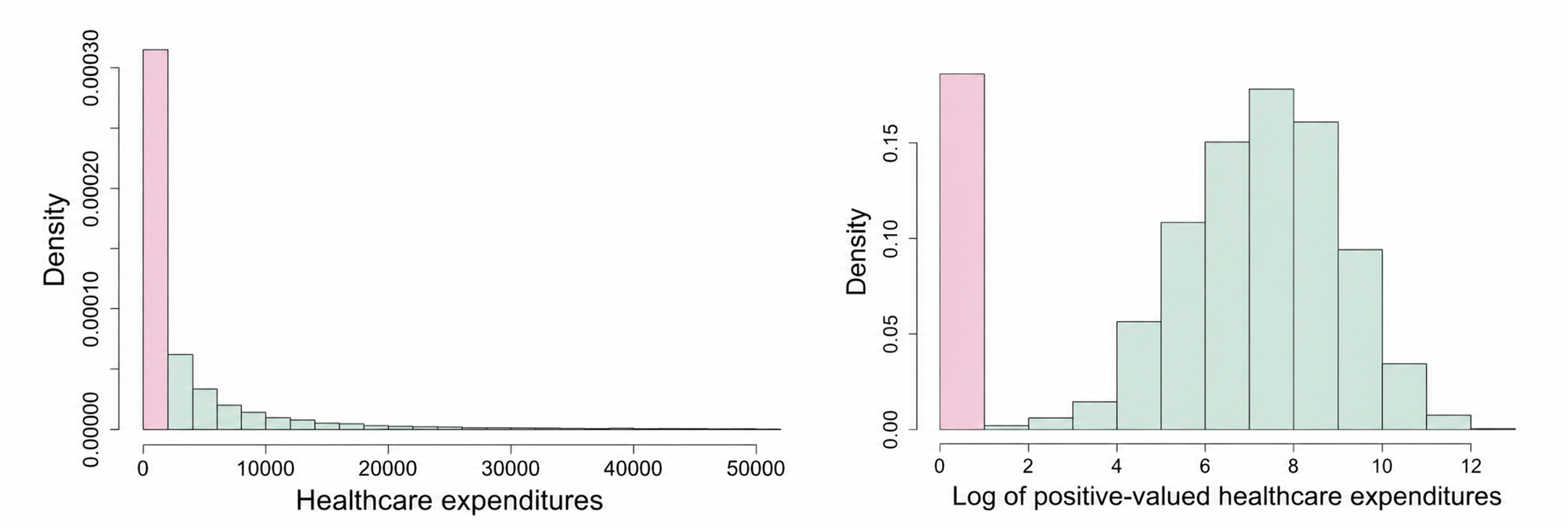
This study decomposes observed disparities into components attributable to differences in mediator distributions and a residual component that remains after equalizing those distributions. Using MEPS data, we specifically examine how disparities in healthcare expenditures may be attributed to socioeconomic status, insurance access, health behaviors, and health status, as well as the disparities that remain after equalizing all observed mediators.